
Beit Shean is the most complete and impressive Roman city in Israel, a vast archaeological park where colonnaded streets, a grand theater, bathhouses, and temples lie spread out beneath a towering ancient mound. Once the leading city of the Decapolis, it was buried by an earthquake in 749 CE and has been excavated to reveal street after street of standing columns. For anyone who loves ancient history, a visit here is like walking through a Roman city frozen in time. This guide covers what to see at Beit Shean, its story, and how to visit.
What is Beit Shean?
Beit Shean is a national park in the Jordan Valley of northern Israel, preserving the ruins of one of the most important cities of the ancient world. In Roman and Byzantine times it was known as Scythopolis, the chief city of the Decapolis, a league of ten Greco-Roman cities. At its height it was home to tens of thousands of people, with paved streets, columns, fountains, and public buildings on a grand scale.
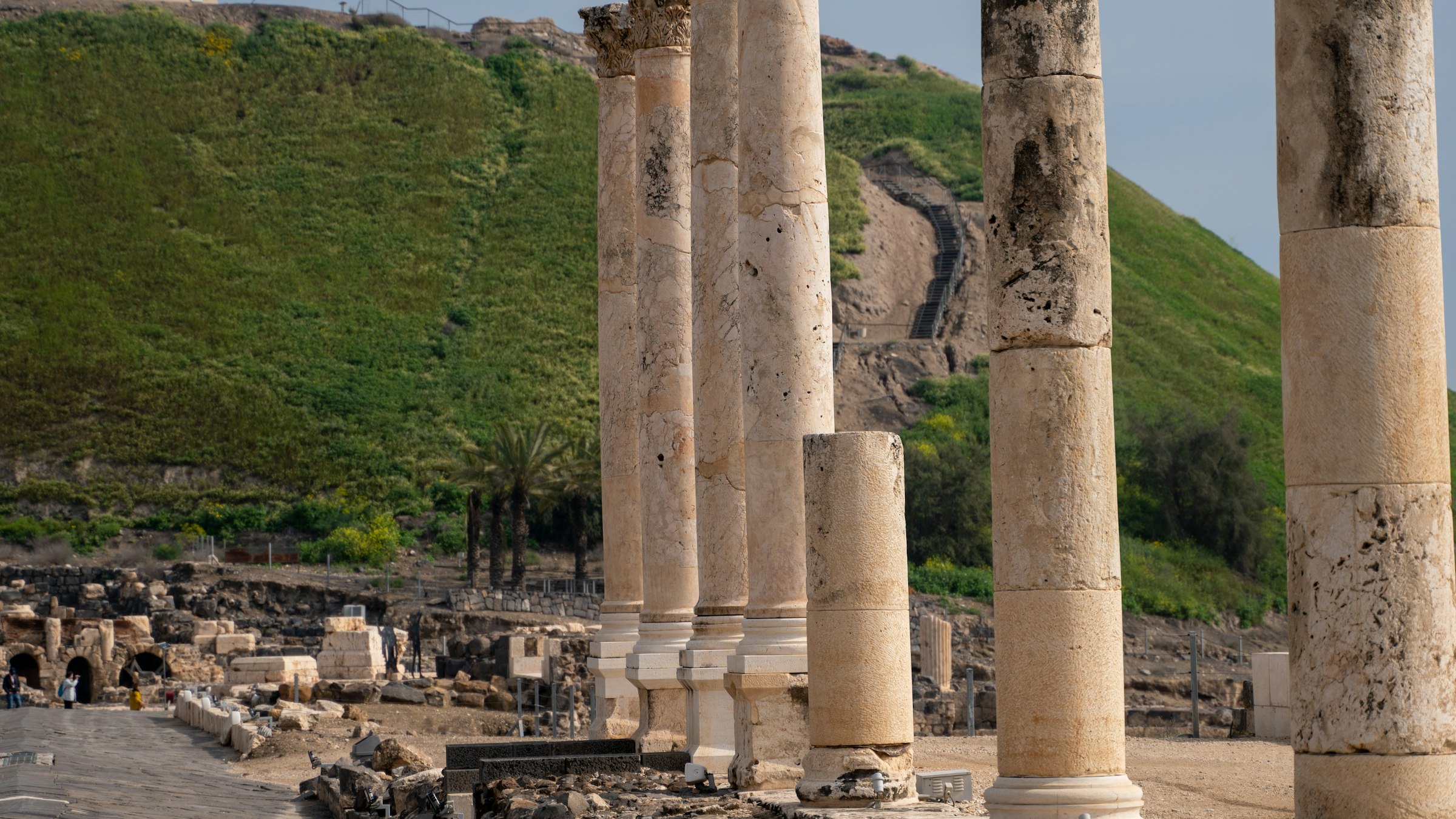
The site has two main parts: the ancient tell, a high mound rising above the ruins where the earliest settlements stood, layered through thousands of years of history, and the sprawling Roman and Byzantine city at its foot. The combination of the mound and the excavated streets makes Beit Shean one of the richest archaeological sites in the country.
Why Beit Shean matters
Few places let you experience a Roman city as vividly as this one. Most ancient sites survive only as scattered stones, but here whole streets of columns still stand, toppled in places exactly as the great earthquake of 749 CE left them. Walking the main colonnaded street, with the theater at one end and the mound looming above, gives a powerful sense of how a Roman provincial capital actually looked and felt.
The site also has deep biblical roots. The ancient tell is mentioned in the Hebrew Bible, and it was on the walls of Beit Shean that the bodies of King Saul and his sons were displayed after the battle of Gilboa. This long history, from the Bronze Age through the Roman peak to the Byzantine and early Islamic periods, is part of what makes the place so remarkable. For more background, see the Beit Shean entry on Wikipedia.
What to see at Beit Shean
The Roman theater
The best-preserved Roman theater in Israel stands near the entrance, once seating around 7,000 spectators. Much of the stone seating and the stage area survive, and you can climb the tiers for a fine view across the ruins.
The colonnaded streets
The heart of Beit Shean is its grand street, Palladius Street, lined with columns and paved with the original stones. Branching avenues, a public bathhouse, and the remains of shops and fountains spread out around it, giving a real sense of the bustling city this once was.
The ancient tell
Rising above the Roman city is the tell, the original settlement mound built up over thousands of years. A path climbs to the top, where you can look out over the whole excavated city below and across the Jordan Valley, a view that ties the layers of history together.
How to visit Beit Shean
The park sits in the Jordan Valley in northern Israel, roughly midway between the Sea of Galilee to the north and Jericho to the south, about a 30 minute drive from the southern tip of the lake. It is run by the Israel Nature and Parks Authority, with an entrance fee and ample parking. Allow around two hours to walk the theater, the colonnaded streets, and the climb up the tell.
Because it lies a little off the main tourist trail, Beit Shean is best reached by car or on a guided tour, often combined with the sites around the Sea of Galilee or with a day in the Jordan Valley. A guided visit brings the ruins to life with the history behind the stones. To see how it fits with the rest of the country, browse all our Israel tours.
Visiting tips for Beit Shean
Go early or late in the day, as the site is largely open with little shade and the Jordan Valley is one of the hottest parts of the country. Bring a hat, sunscreen, and plenty of water. Wear sturdy shoes for the uneven ancient paving and the climb up the tell. Allow about two hours for a full visit. In summer, the site sometimes runs a night experience with sound and light among the illuminated columns, which is worth checking when you plan your trip.
Visit Beit Shean with us
Frequently asked questions about Beit Shean
What is Beit Shean known for?
Beit Shean is known as the most complete Roman city in Israel, with a well-preserved theater, colonnaded streets, bathhouses, and temples. Known in Roman times as Scythopolis, it was the leading city of the Decapolis before an earthquake destroyed it in 749 CE.
Where is Beit Shean located?
It is in the Jordan Valley in northern Israel, between the Sea of Galilee to the north and Jericho to the south. The park is about a 30 minute drive from the southern end of the Sea of Galilee, which makes it easy to combine with a Galilee trip.
How long does it take to visit Beit Shean?
Plan for about two hours to see the Roman theater, walk the colonnaded streets, and climb the ancient tell for the view over the city. History enthusiasts may want a little longer to take it all in.
Is Beit Shean worth visiting?
Yes, especially for anyone interested in ancient history. Few sites anywhere let you walk through streets of standing Roman columns the way Beit Shean does, with the dramatic added backdrop of the ancient mound rising above the ruins.
What happened to the ancient city?
The Roman and Byzantine city of Scythopolis was devastated by a powerful earthquake in 749 CE, which toppled its columns and buildings. Many of the fallen columns still lie where they came down, which is part of what makes the ruins so striking today.
Can you combine Beit Shean with the Sea of Galilee?
Yes. Beit Shean sits about 30 minutes south of the Sea of Galilee, so a Galilee or Jordan Valley day tour can comfortably include it. A guided itinerary often pairs the Roman ruins with the lakeshore sites to the north.
Plan your visit
Beit Shean is a rare chance to walk through a Roman city almost as it stood, a highlight for anyone who loves the ancient world. Explore the nearby Sea of Galilee and Jericho, or browse all our Israel tours. Questions before you book? Message us on WhatsApp at 08-6338361 or email sales@booking-tours.com and a real person from our Eilat office will answer.